Friday, August 29, 2008
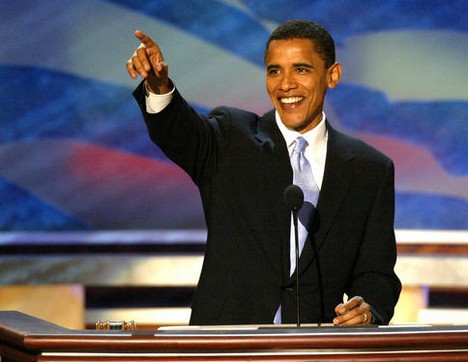
DENVER — Barack Obama accepted the Democratic presidential nomination on Thursday night with a scathing assessment of John McCain and a searing indictment of the Bush administration, promising to repair "the broken politics of Washington" and preside over a more prosperous and equitable America.
Speaking to a rapturous audience of about 80,000, the largest convention crowd ever assembled, Obama delivered an address that was alternately outraged and uplifting, personal and political.
He blasted President Bush and McCain, the presumptive Republican nominee, with some of his harshest language of the campaign, painting a grim picture of economic hardship: rising unemployment, falling wages, plunging home values and rising costs for gasoline and college tuition.
"Tonight," Obama said, speaking from a specially constructed soundstage on the floor of Denver's Invesco Field, "I say to the American people, to Democrats and Republicans and Independents across this great land — enough! This moment — this election — is our chance to keep, in the 21st century, the American promise alive."
In a 40-minute speech, Obama rode a line between policy and personal revelation, between high-flown oratory and an elbow-grease appeal to the working class voters who have stubbornly eluded him throughout the campaign.
He slapped McCain even as he called for an end to Washington's partisan politics, including appeals for common ground on some of the nation's most contentious issues: abortion, gay rights, gun control and immigration.
And he addressed nearly every major criticism of himself and his campaign head-on.
After a passing salute to McCain and his heroic military service, Obama scorched his rival on issues of policy and judgment.
"I don't believe that Senator McCain doesn't care what's going on in the lives of Americans," he said. "I just think he doesn't know." And: "John McCain likes to say that he'll follow bin Laden to the Gates of Hell — but he won't even go to the cave where he lives." And "John McCain has voted with George Bush 90 percent of the time. ... I don't know about you, but I'm not ready to take a 10 percent chance on change."
Obama salted his speech with the stories of people he met on the campaign trail, suggesting he was not as exotic or distant as his mixed-race background and cool demeanor sometimes suggests.
Obama pledged "to end this war in Iraq responsibly and finish the fight against al-Qaida and the Taliban in Afghanistan;" vowed to wean the U.S. from Middle Eastern oil in a decade, and cut taxes "for 95 percent of all working families," and he said he'd pay for it all in the budget.
He declared himself "not the likeliest candidate for this office. I don't fit the typical pedigree, and I haven't spent my career in the halls of Washington." But he challenged McCain on issues domestic and foreign, declaring "If John McCain wants to have a debate about who has the temperament, and judgment, to serve as the next commander-in-chief, that's a debate I'm ready to have."
Melding his signature line and his rival's convention theme, Obama said the nation's troops "have not served a Red America or a Blue America — they have served the United States of America. So I've got news for you, John McCain: We all put our country first."
For the most important night of his political career, Obama chose a setting as audacious as his candidacy itself: a raised blue-carpeted platform at the center of a football stadium, with a backdrop of Greco-Tuscan columns and more than a dozen American flags. The campaign surrounded the stage with a multi-ethnic rainbow of delegates and filled the stands with ticket lottery winners, striving for an image at once mammoth and intimate.
The stadium fell whisper-silent as Obama's video of introduction played, a gentle, cool breeze lifting the American flags in the hands of rapt audience members.
Republicans mocked the spectacle, calling it further proof the Democratic nominee was an empty-suited celebrity smitten with himself. McCain was hoping to steal back a bit of the limelight today by announcing his vice presidential pick.
Whatever happens in November, the night presented a testimonial to racial progress in America, a nation founded by slave owners and cleaved by civil war and more than a century of acrimony that followed.
Less than 50 years after African-Americans were prevented from voting in some states, Obama became the first African-American to accept the presidential nomination of one of the country's two major political parties.
Adding to the historic resonance, Obama delivered his speech on the 45th anniversary of the Rev. Martin Luther King Jr.'s "I Have a Dream" address. "Let freedom ring from the snowcapped Rockies of Colorado!" King said that day; Obama's triumph, standing in the shadow of those mountains, suggested the country was closer to the colorblind society King saw in 1963 from the steps of the Lincoln Memorial.
Democrats hardly mentioned the historic nature of Obama's nomination for most of the night, until the candidate himself, at the end of his speech, borrowed the 45-year-old words of the man he called "the preacher."
As Obama quoted Martin Luther King: " 'We cannot walk alone,' the preacher cried. 'And as we walk, we must make the pledge that we shall always march ahead. We cannot turn back.' "
"America," Obama concluded, "we cannot turn back. We cannot walk alone. At this moment, in this election, we must pledge once more to march into the future. Let us keep that promise — that American promise — and in the words of Scripture hold firmly, without wavering, to the hope that we confess."
Tuesday, July 8, 2008

KABUL, Afghanistan — A huge blast from a suicide car bomb at the gates of the Indian Embassy on Monday killed 41 people in the deadliest suicide car bombing since the American-led invasion of Afghanistan in 2001 ousted the Taliban.
Among the victims of the attack, the first in seven years on a regional diplomatic mission in Afghanistan, were at least four Indian citizens: the Indian defense attaché, a political counselor and two other Indian officials. Six Afghan police officers were also killed. Many of the rest appeared to be civilians.
The fact that the Indian Embassy was attacked raised suspicions among Afghan officials that Pakistani operatives allied with the Taliban had used the bombing to pursue Pakistan’s decades-long power struggle with India.
India said it would send a delegation to Pakistan to investigate what the Indian Foreign Ministry called “this cowardly terrorist attack.”
There have been a number of attacks in Afghanistan in recent months notable for their increased sophistication and deadliness. Afghan and Western officials have said such attacks are signs of the growing strength of militants in the Pakistani tribal areas bordering Afghanistan, and the influence of Al Qaeda and other foreign terrorists and even elements of Pakistan’s premier intelligence agency, the Inter-Services Intelligence.
Suicide bombers attacked the five-star Serena Hotel in January and mounted a sophisticated assassination attempt on President Hamid Karzai during a military parade in April, an attack that Afghan intelligence directly linked to the Inter-Services Intelligence.
Pakistani intelligence has had a long involvement in supporting militant groups fighting in Kashmir and Afghanistan as a means to influence regions on its borders, and according to some Western diplomats and military officials, they maintain those links today, including with some elements of the Taliban.
In a statement Monday, Mr. Karzai said the “enemies of peace in Afghanistan” wanted to hurt Kabul’s international relationships, “particularly with India.”
“Such attacks will not hamper Afghanistan’s relations with other nations,” Mr. Karzai said.
The attack comes amid the worst summer fighting Afghanistan has seen since the fall of the Taliban in 2001, and as concerns mount about the weakness of the Karzai government. Taliban insurgents have proved resilient, NATO and military officials said, and killed 46 members of the international force serving here in June. That was the highest toll since the invasion in 2001.
The Indian Embassy is located on a leafy thoroughfare close to the Afghan Interior Ministry, in what is supposed to be one of the best-guarded neighborhoods of the city, protected by police roadblocks. But the bomber managed to get through, and rammed a car laden with explosives into the embassy gates.
Witnesses said the bomber struck as two diplomatic vehicles were approaching the gates. Nearby, people were standing in line for visas and shopping in a market. The explosion left body parts and bloodstained clothing strewn in the wreckage. Ambulance sirens wailed as residents peered at the wreckage of a dozen vehicles.
Haji Khial Mohammad, 45, one of those in line for an Indian visa, said he saw more than a dozen who appeared to be dead. “I was shocked and could not hear anything after the attack,” he said. “But I saw at least 10 men and three women in the queue who were probably killed.”
Mohammad Ajmal, 26, a shopkeeper in the market, said the explosion sent goods from his shelves spilling out. “I could barely could stand up,” he said.
A spokesman for the Taliban, Zabiullah Mujahed, denied responsibility. “The suicide bomb attack was not carried out by Taliban, we strongly reject that accusation,” he said by telephone. “We don’t know who carried it out.”
The Taliban frequently disavows knowledge of attacks that cause heavy civilian casualties.
Pakistani intelligence has had a long history of supporting militant groups fighting in Afghanistan and Kashmir, officials here said, and has regarded Afghanistan as its backyard. It fiercely resents the growing influence there of regional rival India. The Afghan Interior Ministry said it believed the attack was carried out in collaboration with “an active intelligence service in the region.”
The ministry did not elaborate on the identity of that service. But relations between Afghanistan and Pakistan have become so strained after a series of attacks that Mr. Karzai has threatened to send troops across the border to attack militants operating from bases in Pakistan.
India, meanwhile, is a close ally of Afghanistan. It is spending $750 million on building roads and power lines here in what has become India’s biggest bilateral aid program ever.
It has opened consulates in several parts of the country, and promoted initiatives to offer scholarships for Afghan students.
But there have been some challenges to its influence. Several Indian workers have been killed in recent months, and Indian television shows have been restricted because of objections on religious grounds. Senior Indian Foreign Ministry officials have said for months that they were worried about the safety of Indian personnel in Afghanistan.
Abdul Waheed Wafa reported from Kabul, Afghanistan, and Alan Cowell from Paris. Sangar Rahimi contributed reporting from Kabul, Somini Sengupta from New Delhi and Carlotta Gall from Islamabad, Pakistan.
Monday, July 7, 2008

Four bombs exploded in Pakistan's port city of Karachi on Monday injuring at least 40 people and killing one.
The explosions occurred in Banaras Chowk, Oraangi town, Shahrah-e-Noor area and Paharganj areas, rescue workers said.
At least 16 people were injured in two blasts in Banaras in Karachi while five others were injured in Shahra-e-Noor Jahan, near Sohail mosque.
Five more people were injured in a blast near a school in Hyderi.

Funerals have been held in Pakistan for the victims of a suicide bomb attack in the capital, Islamabad.
Yusuf Reza Gilani, Pakistan's prime minister, on Monday denounced the bombing that killed at least 20 people - mostly police - near a police station.
Sunday's attack was carried out just several hundred metres from the site of a rally marking one year since a deadly government raid on the Lal Masjid (Red Mosque).
After visiting some of the 50 people wounded by the blast, Gilani said: "This is against humanity. The law will take the culprits in its grip."
Police continued to investigate at the scene, discovering a severed head in bushes beside the road where the attack took place, according to Reuters news agency.
The heads of suicide bombers are often severed by the explosives strapped to their torsos.
Rehman Malik, the interior ministry chief, said a teenage boy was the suspected attacker.
Speaking to Geo TV hours after the explosion, he said: "All witnesses say that a 15- or 16-year-old boy, who had a light beard and wore a white shalwar kameez ... he came walking toward our police and blasted himself."
Al Jazeera's Kamal Hyder, reporting from Islamabad, said that the explosion happened on the edge of the security cordon.
People were leaving the mosque after the mostly peaceful rally when the attack targeting the police occurred, he said.
Rally marred
Thousands of police had been deployed across the capital for Sunday's memorial and a tight ring of security was in place around the gathering in front of the mosque.
Barbed wire and fences had been put up to prevent vehicles from entering the area while pedestrians had to pass through metal detectors.
Hyder said the bombing was likely to jeopardise the government's attempts to engage the leaders of armed groups carrying out attacks in the country.
There was some evidence to suggest that there were splinter groups that were not in favour of rapprochement with the government, he said.
Imtiaz Gul, a political analyst in Islamabad, told Al Jazeera that the attack came after threats from the Pakistani Taliban in northwest regions bordering Afghanistan.
"Baitullah Mehsud had indicated and threatened that if his people, with whom the government was talking ... if their prisoners are not released ... they would take revenge," he said.
"They clearly indicated it would be in Islamabad, Lahore or another big Pakistani city."
There were no immediate claims of responsibility for the blast.
Pakistani troops surrounded the mosque last July, clashing with pro-Taliban and alleged al-Qaeda members who were holed up inside before storming the building.
More than 100 people were killed in the military operation.
'Rooting out terrorism'
Pervez Musharraf, the president who ordered last year's assault, reiterated the government's "commitment to root-out terrorism in all its forms and manifestations", the state-run Associated Press of Pakistan news agency said.
He urged Gilani's government to do more to combat anti-government groups, warning that otherwise there would be "Red Mosques everywhere".
The level of violence in Pakistan has fallen since last year, but attacks are still relatively frequent.
In June, a suicide car bomber killed at least six people near the Danish embassy in Islamabad.
A statement attributed to al-Qaeda claimed responsibility for that blast, which was believed to have targeted Denmark over the publication of cartoons depicting the Prophet Muhammad.
Sunday, July 6, 2008
Flames raise in front of a police building in Weng'an China on Saturday, June 28, during a protest over officials' reaction to a student's death.
Aftershocks from the huge protests that took place on June 28 in the remote town of Weng'an continue to reverberate, with news breaking Friday that both the local Communist Party commissar Luo Liaping and the chief of police, Shen Guirong have been dismissed for what official media reports described as "severe malfeasance." Such speedy and decisive action by Beijing is, to put it mildly, unusual. That reflects both the gravity of the riot, which involved up to 30,000 people, and a desire by the central authorities — currently consumed by the build up to the Olympics — to stop the protests from continuing. But there are other signs that the incident is more than a mere pre-Olympics anomaly and may be part of a new, more open approach by Beijing to outbursts of long-simmering rage.
On June 28, tens of thousands took to the streets of Weng'an, a rural town in remote Guizhou Province, to protest what they believed was a cover up by the local authorities of the alleged rape and murder of a 15 year-old schoolgirl, Li Shufei. The protesters torched upwards of 20 cars and set fire to both the local police station and the Communist Party headquarters. Even before the dismissals of top local officials, it was clear this incident was going to be treated differently. On July 3 the provincial governor, Shi Zongyuan, made an unusually blunt statement condemning the conduct of the local police. His words drew a surprisingly revealing picture of the reasons behind the incident. Although on the surface it was sparked by the controversy over the schoolgirl's death, the governor said, the real reasons for the scale and violence of the protests were the suppressed anger at the behavior of local officials. He cited the demeanor of local government officers in denying residents the economic benefits of mining (read, large scale corruption) and the use of force during the resettlement of migrants and forced demolitions to make way for development projects
The governor's comments were particularly unexpected given that such protests in a remote county like Weng'an would normally be relatively unremarkable. Even the central government admits that such "mass event," as it terms them, are common, noting that some 87,000 occurred in 2006 (though the definition of what exactly constitutes a mass incident is vague).
Coverage of the "mass event" by the state media was also surprising. Normally such stories are ignored or simply dismissed by noting, for example, that a dozen farmers were arrested for disturbing social order. But this was different. Xinhua, China's official news agency, responded quickly and produced unusually long investigative stories. China's two largest websites, Sina and Sohu, published a headline about the incident on their front pages and updated their stories every few hours. And the local Guizhou television network broadcast live coverage up to 24 hours after the incident occurred, even showing the Weng'an police headquarters in flames, usually a strong taboo in China.
The Weng'an incident and its seemingly more open coverage are signs of the greater latitude enjoyed by the state media in the wake of the May 12 Sichuan earthquake. While the more lenient earthquake coverage appeared to be a spontaneous decision taken by Beijing, some observers believe that the extensive coverage of Weng'an could be a direct result of a policy change in Beijing signaled by a speech given in late June by Chinese President Hu Jintao. During a visit to offices of the Party mouthpiece, the People's Daily, Hu stressed that the media needed to concentrate on molding the public's perceptions of news events and presenting their reports in a more attractive and innovative way. To close observers of the party, this appeared to signal a new policy direction. "It seems the party will allow the Chinese media to report more transparently," says Russell Moses, a Beijing based scholar, "though of course they still dictate the lines of authority."
If the traditional media's coverage of Weng'an was allowed to be more "open," however, the online censors didn't seem to have got the same memo. The struggle between the ever inventive Chinese users of the Web and the Great Firewall, the Chinese internet censorship system, could be seen in a sort of online game of whack-a-mole, as posts, pictures and video of the rioting and its causes were deleted within hours, or even minutes, of being posted. But the locals have continued to create new ways to avoid being blocked. Instead of posting on social discussion forums, where such topics are usually raised, netizens wrote about the incident on video game bulletin boards and other unrelated sites. They also used jocular code words for the incident ("bonfire party") and deployed special software that reversed sentence order so that lines ran from right to left and horizontally instead of vertically. Xiao Qiang, a Berkeley-based Chinese media expert thinks the government censors lost this round. "In this particular case, netizens' anger was just too strong to be suppressed," he says.