Sunday, July 6, 2008

TOKYO (AFP) — The Group of Eight richest nations is likely to pledge at the upcoming summit to take the lead in efforts to halve emissions of greenhouse gases by 2050, a newspaper said Sunday.
Leaders of the G8 -- France, Germany, Britain, Canada, Japan, Italy, Russia and the United States -- are to start a three-day meeting Monday in the northern Japanese spa report of Toyako.
At the previous summit last July, host country Germany overcame fierce US resistance and coaxed the rich nations' club into agreeing to "consider seriously" the goal of at least halving worldwide emissions by 2050.
For the Toyako summit, negotiations are in the final stages for a leaders' declaration saying "the G8 will take the lead in making efforts to halve" emissions or something similar, the Yomiuri Shimbun said.
Europe and Japan want to upgrade the expression "consider" in Germany to "agree" but the United States has been seeking an accord that would include China, India and other major emitters, Japan's best-selling newspaper said.
Another major daily, the Asahi Shimbun, reported Sunday that developed countries, including the United States, are to agree to set their own mid-term targets in cutting gas emissions.
The developed nations' pledge for country-by-country mid-term targets will be in a leaders' statement of 16 countries, including the G8 and developing countries, to be held on Wednesday, the newspaper said.
Japan's environment minister, Ichiro Kamoshita, said Sunday that Japan was unlikely to volunteer to declare its mid-term target at the upcoming summit.
"We should weigh this against our national interest. We will have heated discussions on mid-term targets from now," he told public broadcaster NHK.
Japan has vowed to cut its greenhouse gas emissions by 60-80 percent by 2050 but said it would only announce a mid-term goal next year.
Saturday, July 5, 2008
American Muslim community is alarmed at the proposed Justice Department policy change that would allow the FBI to investigate Americans without evidence of wrongdoing, relying instead on a terrorist profile that could single out Muslims and Arabs.
Under the new guidelines, which are expected to be implemented later this summer, the FBI would be permitted to consider race and ethnicity when opening an investigation, according to an Associated Press report.
Agents would also be allowed to ask open-ended questions about the activities of American Muslims and Arab-Americans, and could initiate an investigation if a person's employment or background is labeled as "suspect" by government analysts looking at public records and other information.
Currently, FBI agents need specific reasons — like evidence or allegations that a law probably has been violated — to investigate U.S. citizens and legal residents. The new policy, law enforcement officials said, would let agents open preliminary terrorism investigations after mining public records and intelligence to build a profile of traits that, taken together, were deemed suspicious.
The policy changes would allow FBI agents to ask open-ended questions about activities of Muslim- or Arab-Americans, or investigate them if their jobs and backgrounds match trends that analysts deem suspect.
Among the factors that could make someone subject of an investigation is travel to regions of the world known for terrorist activity, access to weapons or military training, along with the person's race or ethnicity.
American Muslim organizations and civil right groups have expressed deep concern over the proposed policy changes.
American Muslim Voice (AMV) founding Executive Director, Samina Faheem Sundas, while expressing concern over the proposed policy, said that the seven-million strong American Muslim community has seen erosion of its civil rights in the post-9/11 America and profiling of Muslims has now become institutionalized.
“Official profiling of Muslims and Arabs began with the Attorney General Ashcroft’s announcement in November 2001 to target about 5,000 young men of Middle Eastern and South Asian heritage who entered the country in the last two years on non-immigrant visas but who were not suspected of any criminal activity for questioning by the federal government,” she said.
The American-Arab Anti-Discrimination Committee (ADC) National Executive Director Kareem Shora urged Americans not tolerate in any way profiling based on race, religion, ethnicity, or national origin. “We will continue to address this issue until we can confirm that these new guidelines do not violate our constitutional principles of justice, freedom, due process, and equality under the rule of law,” he added.
The Arab American Institute (AAI) President Dr. James Zogby said that millions of Americans who, under the reported new parameters, could become subject to arbitrary and subjective ethnic and religious profiling.
“This will compromise basic civil liberties and constitutional protections, having a negative impact not only on the affected communities, but on the United States' overall effort to combat terrorism.”
The National Legislative Director of the Council on American-Islamic Relations, Corey Saylor, said "Initiating criminal investigations based on racial or religious profiling is both unconstitutional and un-American." He said any new Justice Department guidelines must preserve the presumption of innocence that is the basis of our entire legal system.
“These guidelines seem to be emanating from the DOJ’s criminal division, which has failed to meet with our groups,” said Salam Al-Marayati, Executive Director of the Muslim Public Affairs Council (MPAC). “If implemented as described in media reports, these new guidelines will make suspects out of our communities and strike a blow to more than seven years of constructive engagement with law enforcement officials.”
The FBI will be allowed to begin investigations simply "by assuming that everyone's a suspect, and then you weed out the innocent," said Caroline Fredrickson of the American Civil Liberties Union.
Arab, Muslim and other civil rights organizations contacted John Miller, FBI Assistant Director for Public Affairs, to raise alarm and opposition to any form of racial or religious profiling which violate Constitutional principles of equal protection under the law.
Miller said that the Department of Justice is still in the process of drafting the guidelines. “Any review and change to the guidelines will reflect our traditional concerns for civil liberties, the First Amendment, and our emphasis on using the least intrusive instigative tools possible,” he added.
He urged the civil rights group against jumping to conclusions, especially those based on conjecture by people who have not seen the new guidelines, since a final draft is not complete.
According to the AP report, Attorney General Michael Mukasey acknowledged the overhaul was under way in early June, saying the guidelines sought to ensure regulations for FBI terror investigations don't conflict with ones governing criminal probes. He would not give any details. "It's necessary to put in place regulations that will allow the FBI to transform itself ... into an intelligence gathering organization in addition to just a crime solving organization," Mukasey told reporters.
The Associated Press said although the guidelines do not require congressional approval, House members recently sought to limit such profiling by rejecting an $11 million request for the FBI's security assessment center. Lawmakers wrote it that was unclear how the FBI could compile suspect profiles "in such a way as to avoid needless intrusions into the privacy of innocent citizens" and without wasting time and money chasing down false leads.
The denial of funding could limit the FBI's use of profiles, or "predictive models and patterns of behavior" as the government prefers to describe the data-mining results, but would not change the guidelines authorizing them. The guidelines would remain in effect until a new attorney general decided to change them.
by Abdus Sattar Ghazali

WASHINGTON — Jesse Helms, the former U.S. senator from North Carolina who for half a century infuriated liberals with his race-baiting campaign tactics and presidents of both parties with his use of senatorial privilege, died Friday. He was 86.
Helms, who won election to the Senate five times before retiring in 2003, died early Friday at a nursing home in Raleigh, N.C., according to John Dodd, president of The Jesse Helms Center in Wingate, N.C. A cause of death was not given, but his family said in 2006 that he had been diagnosed with vascular dementia.
"Jesse Helms was a kind, decent, and humble man and a passionate defender of what he called 'the Miracle of America.' So it is fitting that this great patriot left us on the 4th of July," President George W. Bush said in a statement Friday.
Commentator Patrick Buchanan, speaking Friday on MSNBC, put Helms in the company of the late President Ronald Reagan, calling the former senator "the second most important conservative of the second half of the 20th Century."
A registered Democrat in the years before he ran for the Senate in 1972, Helms was not the only Southerner of his generation to defect to the GOP after his party championed the cause of civil rights and, as he put it, "veered so far to the left nationally." Nor was he, at his death, the only politician defending the traditional values of a rural South that had long since been suburbanized.
But Helms will be remembered as different from his contemporaries in that he was unyielding on issues that were important to him. Unlike other conservatives, such as Mississippi Sen. Trent Lott or former Georgia Rep. Newt Gingrich, who fought for their causes but found ways to reach accord with Democrats, Helms—who acquired the nickname Senator No—seldom gave in.
Unlike other symbols of segregation — such as Alabama Gov. George Wallace and longtime South Carolina Sen. Strom Thurmond, who recanted their opposition to racial integration — Helms held firm. He rarely reached out to black voters, who in the 2000 census represented nearly 25 percent of North Carolina's population.
The key to Helms' longevity was a political strategy that allowed him to win election without appealing to the mainstream. The use of direct mail to solicit campaign funds nationally was pioneered in the 1960s, but Helms perfected the approach. He sought campaign contributions from conservatives nationally, then used their money to air inflammatory ads that energized his conservative base at home.
Helms never won with more than 56 percent of the vote, but he maintained a devoted core constituency.
Often he was the lone voice of dissent in the Senate. He was the only senator to vote against confirming Henry Kissinger as secretary of state during the Nixon administration. And he was the only senator to vote against making Rev. Martin Luther King Jr.'s birthday a holiday.
And on any number of issues he pushed his conservative agenda in the Senate. He filibustered a bill setting national standards for education to try to force inclusion of a constitutional amendment encouraging prayer in schools. And he pushed for an amendment to the Americans with Disabilities Act that would have barred employees with AIDS from handling food at restaurants.
Helms attended Wake Forest University but did not graduate.
One of his first jobs after college was as a sportswriter for the Raleigh News & Observer. There he met Dorothy Coble, the society reporter. They married in 1942. They had two daughters and adopted a 9-year-old boy with cerebral palsy who had said in a newspaper article that he wished for a family.
Los Angeles Times

Friday, July 4, 2008
WARSAW, July 4 (Reuters) - Poland rejected as insufficient on Friday a U.S. offer to boost its air defences in return for basing a "missile shield" on its territory but said it remained open to further talks with Washington.
The decision by Poland, a staunchly pro-American NATO ally, is a setback for the Bush administration's plans for global missile defence, which is intended to counter possible threats from what Washington calls "rogue states", particularly Iran.
"We have not reached a satisfactory result on the issue of increasing the level of Polish security," Prime Minister Donald Tusk told a news conference after studying the final U.S. proposal.
"The aim of the negotiations, in my view, is to enhance the security of our country. We still agree that it is fundamental for us to maintain our alignment with the United States, which has been, is and will continue to be our strategic ally."
In Washington, a White House spokesman said the United States would continue its talks with Poland.
"Discussions will continue," Gordon Johndroe told Reuters in an e-mail message.
The details of the U.S. offer have not been made public, though Tusk said it included a proposal to site Patriot ground-to-air missiles on Polish soil for one year.
In the months-long negotiations, Tusk's centre-right government had sought billions of dollars worth of U.S. investment to upgrade Polish air defences in return for hosting 10 missile interceptors.
"We are ready to accept proposals or corrections from the American side which would include our proposal to increase (our) security. We can do this in a day, a week, a month," Tusk said.
The Czech Republic has agreed to host a tracking radar under the project. Its parliament has still to ratify the deal.
Russia has condemned the missile defence plan as a threat to its own security and has said it will target missiles at Poland and the Czech Republic -- its communist-era satellite states -- if the deployment goes ahead.
THREAT
"If the threat related to the shield indeed increases, then we need elements such as Patriots on Polish territory, and not just for one year," Tusk said, adding that the problem was not a question of money.
Political analysts said Tusk's rebuff to Washington demonstrated a new Polish self-confidence on the global stage. Warsaw is one of Washington's firmest allies in the region and has troops serving alongside its ally in Iraq and Afghanistan.
"This is the first time that Poland has said 'no' to the U.S. ... It certainly sends a signal to Washington that Poland's support should not be taken for granted in any circumstances," said Pawel Swieboda, head of demosEuropa, a Warsaw think-tank.
"But it is also the case that the government greatly raised expectations and that these were never very realistic. Poland does need some compensation (for hosting the interceptors) but they went too far in demanding Patriots."
Polish President Lech Kaczynski, a right-wing opponent of the Tusk government and a strong supporter of the shield plan, is now likely to step up his attacks on the government.
But analysts said the domestic political fallout would be limited as Polish voters are largely hostile to the project.
Washington has said it wants Poland to host the interceptors but that it would look elsewhere if Warsaw declines to take part. The Baltic republic of Lithuania, northeast of Poland, has been mooted as an alternative site for the interceptors. (Writing by Gareth Jones; Editing by Stephen Weeks)
By Patryk Wasilewski and Gareth Jones

Sunday, January 6, 2008
The unrest and political turmoil prevailing in the country is badly jeopardising the events related to sports in general and the cricket activities in particular. The Quaid-e-Azam Trophy successfully completed its ten rounds. The situation that worsened after the assassination of former Prime Minister Benazir Bhutto, however, compelled the Pakistan Cricket Board (PCB) to call off the eleventh round and postpone the matches played all over the country to a later date.
The next event that causes a major worry to the whole nation is a question mark on the Australian Team’s tour of Pakistan scheduled for March-April 2008. This being the Australia’s tour of Pakistan after a lapse of ten years, the millions of cricket fans are over-anxious to watch them in action. Since the tour is still about ten weeks away it is expected that the Australians will not deprive our cricket fans of the excitement that they have waited since long. While Cricket Australia has no plans of calling off the tour, it is quite likely that around half a dozen super stars will not accompany the squad. Considering it as their right to do so, the Australian Cricketers’ Association has decided to support the players.
Living in a paradox skipper Shoaib Malik plans to approach the top Australian players on personal net in a bid to ease their minds about conditions in Pakistan and to convince them to play the series. He wants to speak to them on phone and tell them that: “we will have good security for you.” I feel Shoaib is too small in stature to convince them. The postponement of general elections has further aggravated the situation. The Australians had planned to send their security mission after the elections. With elections now set for February 18, it would only leave a fortnight between the country going to polls and the Australian team’s arrival. They feel it would give Australia’s security mission little time to make its assessment and be able to sanction the tour. Former captain turned politician Imran Khan feels that “the cricketers are not under any threat. The Australia’s tour of Pakistan should go ahead”. Let us hope the PCB convinces the Aussies on this point.
Pakistan being the land of chronic political problems, there were occasions in the past when we had to play such series on neutral grounds in neighbouring countries. Way back in 2002 on account of the security fears sparked in the aftermath of 9/11 when Australia refused to tour Pakistan, the series was played in Colombo. Earlier in the same year, the West Indies refused to play in Pakistan and the matches were shifted to Sharjah. New Zealand had to cut short its trip to Pakistan as the result of a bomb blast outside their hotel in Karachi in May 2002. South Africa, India and England refused to play Test matches in Karachi between 2003 and 2005 due to blasts and security fears in the city. The most recent case was of a one day international against South Africa that was shifted from Karachi after Benazir Bhutto survived a bomb blast on October 18. It may also be noted that for the last many years we have not staged an international match in Peshawar due to the fears caused by unrest in Afghanistan and some parts of NWFP. PCB chief Nasim Ashraf has, however, ruled out any chance of staging the forthcoming series at a neutral venue.
The Australia tour being still away, the Zimbabwe cricketers are scheduled to land in Karachi on January 12 to play a series of five ODIs. There appears to be no reluctance on their part to visit Pakistan although the PCB is prepared to reschedule the tour in view of change in the election date if required. The people of advanced countries, having a relatively peaceful atmosphere, are not tuned to the way of life in politically disturbed regions. In contrast, in the under-developed or politically unstable countries the violence, riots, disturbances and even blasts are a part of daily life. Their people thus possess much stronger nerves to face all sorts of troubles. I remember during the World Cup 1996 there was a bomb blast in Colombo where the Australians and the West Indies were scheduled to play their match. Both the teams were so scared that they refused to go there. Since Sri Lanka had made all the preparations and sold out tickets in full, the match could not be cancelled. After deliberations on the subject, the two organising countries India and Pakistan decided to send their teams to fill the vacuum. The teams played the match and returned safely.
The year 2007 having passed we have stepped into 2008 with high spirits, fresh hopes and aspirations. A cursory glance over the performance of our cricket team during the past year will show that with no laurels worth the name, the defeats and disappointments reigned supreme. The nation’s aspirations were shattered when our team crashed out in the preliminary round of the World Cup at the hands of a team whose name was never heard before. The team, however, managed to win an ODI series against Sri Lanka before it lost the inaugural Twenty20 World Cup final to India. As for the Test series Pakistan lost all the three series, two against South Africa (home and away) and one against archrivals India on their soil. They also lost the ODI series both against South Africa and India. As per statistics for the past year, out of 8 Test matches Pakistan were successful in only one match, while they won 8 ODIs out of 23. Bangladesh with 34.78 percent and Ireland with 30.55 percent are the two teams below Pakistan. This is certainly a deplorable performance. Our team’s poor performance during the year brought them down to an all time low in ICC rankings: number 6. It is high time for the PCB to improve the falling standard of the national cricket team.
Assassination of prominent political leaders, presumably protected by the best security, is no easy thing. It requires agencies of professional intelligence training to ensure that the job is done and that no person is caught alive who can lead to those behind. Typically, from the assassination of Archduke Francis Ferdinand in Sarajevo in July 1914 to US president John Fitzgerald Kennedy in 1963, the person pulling the trigger is just an instrument of a far deeper conspiracy. So too in the assassination on December 27 of former Pakistani prime minister Benazir Bhutto. Cui bono (To whose benefit)?
What was behind the murder of Bhutto at the moment her Pakistan People's Party appeared about to win a resounding
election victory in the planned January 8 elections (now postponed to February 18), thereby posing a mass-based challenge to the dictatorial rule of President Pervez Musharraf?
Musharraf's government was indecently quick to blame "al-Qaeda". Musharraf just days after declared he was "sure" al-Qaeda was the author, even though, on US pressure, he has asked Scotland Yard to come and investigate. "I want to say it with certainty, that these people [al-Qaeda] martyred ... Benazir Bhutto," Musharraf said in a January 3 televised address. He named Baitullah Mehsud, a militant tribal chief fighting the Pakistani Army, who has alleged ties to al-Qaeda and the Afghan Taliban. Mehsud denied the charge. Had he been behind such a dramatic event, the desired propaganda impact among militant Islamists would require taking open responsibility instead.
By linking the Bhutto killing to al-Qaeda, Musharraf conveniently gains several goals. First, he reinforces the myth of al-Qaeda, something very useful to Washington at this time of growing global skepticism over the real intent of its "war on terror", making Musharraf more valuable to Washington. Second, it gives Musharraf a plausible scapegoat to blame for the convenient elimination of a serious political rival to his consolidation of one-man rule.
Notable also is the fact that the Musharraf regime has rejected making a routine autopsy on Bhutto's body. Bhutto publicly charged that the government had refused to make follow-up inquiries after the October bombing which nearly killed her and did 134 followers near her car. Bhutto accused the Pakistani authorities of not providing her with sufficient security, and hinted that they may have been complicit in the Karachi attack.
She also made clear in a British television interview shortly before her death that she would clean out the Pakistan military and security services of corrupt and Islamist elements. In the same David Frost interview, Bhutto also dropped the explosive news that Afghan Taliban leader Mullah Omar had killed Osama bin Laden some while back. That fact would make the alleged bin Laden terror videos periodically delivered to Western media clear as forgeries.
Days after the Bhutto killing, Pakistani authorities published a photo alleged to be of the severed head of the suicide bomber who killed Bhutto. Severed heads, like Lee Harvey Oswald (Kennedy's assassin) don't talk or say embarrassing things.
It has been known for months that the George W Bush administration has been maneuvering to strengthen its political control of Pakistan, paving the way for the expansion and deepening of the "war on terror" across the region.
Who was Bhutto?
The Bhutto family was itself hardly democratic, drawing its core from feudal landowning families, but opposed to the commanding role of the army and the Inter-Services Intelligence. Succeeding her father as head of the Pakistan People's Party, Benazir declared herself "chairperson for life" - a position she held until her death.
Bhutto's husband, Ali Zardari, "Mr 10%", is known in Pakistan for his allegedly demanding a 10% cut from major government contracts when Benazir was premier. In 2003, Benazir and her husband were convicted in Switzerland of money laundering and taking bribes from Swiss companies. The family is allegedly worth several billions. As prime minister from 1993 to 1996, she advocated a conciliatory policy toward Islamists, especially the Taliban in Afghanistan.
The Harvard-educated Benazir had close ties to US and British intelligence as well. She used the offices of neo-conservative US Congressman Tom Lantos when she was in Washington, according to informed reports, one reason Vice President Dick Cheney backed her as a "safe" way to save his Pakistan strategic alliance in the face of growing popular protest against Musharraf's declaring martial law last year.
The ploy was to have Bhutto make a face-saving deal with Musharraf to put a democratic face on the dictatorship, while Washington maintained its strategic control. According to the Washington Post of December 28, "For Benazir Bhutto, the decision to return to Pakistan was sealed during a telephone call from Secretary of State Condoleezza Rice just a week before Bhutto flew home in October. The call culminated more than a year of secret diplomacy - and came only when it became clear that the heir to Pakistan's most powerful political dynasty was the only one who could bail out Washington's key ally in the battle against terrorism ... As President Pervez Musharraf's political future began to unravel this year, Bhutto became the only politician who might help keep him in power."
In November, John Negroponte, former Bush administration intelligence czar and now deputy secretary of state, was deployed to Islamabad to pressure Musharraf to ease the situation by holding elections and forming a power-sharing administration with Bhutto. But once in Pakistan, where her supporters were mobilized, Bhutto made clear she would seek an election coalition to openly oppose Musharraf and military rule in the planned elections.
A cynical US-Musharraf deal?
Informed intelligence sources claim a cynical deal was cut behind the scenes between Washington and Musharraf. Musharraf is known to be Cheney's preferred partner and Cheney is said to be the sole person running US-Pakistan policy today.
In terms of this, were Musharraf to agree to the stationing of US special forces inside Pakistan, "Plan B", the democratic farce with Bhutto, could be put aside in favor of the continued Musharraf sole rule. Washington would "turn a blind eye".
On December 28, one day after the Bhutto assassination, the Washington Post reported that in early 2008, "US special forces are expected to vastly expand their presence in Pakistan as part of an effort to train and support indigenous counter-insurgency forces and clandestine counterterrorism units", under the US Central Command and US Special Operations Command, a major shift in US-Pakistan ties. Until now, Musharraf and his military have refused such direct US control.
The elimination of Bhutto leaves an opposition vacuum. The country lacks a credible political leader who can command national support, which leaves the military enhanced as an institution, with its willingness to defend Musharraf on the streets. This gives the Pentagon and Washington a chance to consolidate a military opposition to future Chinese economic hegemony - the real geopolitical goal of Washington.
Saturday, January 5, 2008
Here in Medialand we love to fall for the iconic figure, the convenient allegory, a Western-style protagonist to help explain complex events in distant lands. Hence the lovefest, nay, near deification, surrounding Benazir Bhutto.
The comfortable narrative, repeated endlessly, is worthy of an Andrew Lloyd Webber musical. The woman who saw her destiny as Pakistan's next prime minister was, according to post-assassination analysis, Pakistan's version of Eva Peron: A people's hero, a Muslim feminist, a democrat, pure hope in a corrupt, unstable country riven with medieval Islamic fundamentalism and bristling with a nuclear arsenal.
That's the easy narrative. But its also a dangerously naive and inaccurate one
The reality is that Bhutto was in most ways a throwback to the old Pakistan, and an old Asia, that would best be left behind. She has proved this from the grave by protecting precisely what Pakistan does not need: A family dynasty, and not a particularly good one.
Knowing she might be assassinated by enemies upon her return from exile to return to politics, Bhutto apparently left behind a will crowning her husband, Asif Ali Zardari, co-chairman of her Pakistan Peoples Party. Zardari, known derisively around Islamabad as "Mr. Ten Per Cent" for his alleged cut of government contracts, then declared their 19-year-old son, Bilawal Bhutto, would be the party's co-chairman. In the meantime he will finish his studies at Oxford and get ready to take over the family dynasty, becoming the third Bhutto to be Pakistan's prime minister. He would follow the steps of his murdered mother and his grandfather, Zulfiqar Ali Bhutto, who was hanged for allegedly authorizing the murder of an opponent.
This may seem the way of politics in Asia. India has its Ghandis, North Korea has the cult of the tyrant Kim Jong Il. Thailand worships its king above its democracy. But political dynasties and cults, call them what you may, are ultimately destructive for a nation. Make a dynasty and corruption follows, violence becomes a political tool, the elites enjoy inside access to power and the delights of the treasury.
Bhutto, of course, claimed she was different -- a true democrat. Yet her final political act from the grave, handing over power by fiat to her husband, suggests otherwise. Perhaps we should have expected it. After all, despite her rhetoric about championing universal suffrage, the self-described "daughter of Pakistan" served as "chairman for life" in her own party.
What does the Bhutto dynasty now offer? Very likely the prospect of the younger Bhutto, who has spent most of his life in gold-plated exile, returning to Pakistan when he is 25. Then it will be constitutionally possible for him to run for prime minister and keep the dynasty alive.
Terrific. Just what the world needs. A young, inexperienced leader in charge of a nuclear arsenal. How on Earth could he run a country he hardly knows?
It's not even clear the thoroughly westernized Bhutto can even speak his country's national language, Urdu, though his English is perfectly British. I expect he's now signing up for some intensive language courses to be ready for the destiny that awaits. But he has a lot of studying ahead if he's going to be able to handle Pakistan's mullahs and tribal warlords, the men who have been running the country while he's been attending the Oxford Union learning how to debate.
here will be those who argue that, despite her flaws, her vanity and tremendous ego, Benazir Bhutto is a historic figure by virtue of being the first woman to lead Pakistan. That is an undeniable accomplishment. But the measure of her legacy should be what she did with her two terms as prime minister.
Did she crack down on honour killings of her fellow Pakistani sisters or repeal laws that now make it almost impossible for a Pakistani woman to bring a rapist to justice? No. Did she alleviate poverty? No. This is a woman who, in her first term as prime minister, saw fit to take $6 million from the treasury to buy herself a supply of Evian water while many in her country can't get clean water from their wells.
Did Bhutto cut deals with the Islamic extremists, whose backing she needed, and pave the way for the Taliban rise to tyranny? Yes. Did she really give Pakistan's nuclear technology to North Korea in exchange for missile technology? Yes.
By all means, shed a tear for Benazir Bhutto, who lost to the barbarians when she was murdered in Rawalpindi. At least she professed to be a democrat. Who knows, she may really have taken on the mullahs if she had become the prime minister a third time. But I weep more for Pakistan, a country so desperate that millions of its citizens believed this was the best leader the country could offer.

Friday, January 4, 2008
ISLAMABAD (AFP) — Pakistan President Pervez Musharraf Thursday said there was no government involvement in the assassination of Benazir Bhutto but admitted he was unsatisfied with the probe into her death.
For the first time since Bhutto was killed in a gun and suicide attack that his government blamed on Al-Qaeda, he acknowledged reports that the crime scene had been quickly hosed down, possibly destroying evidence, after her murder.
One week after the popular opposition leader was killed at a campaign rally, and just a day after he said Scotland Yard would send investigators to help, Musharraf conceded he was "not fully satisfied" with the probe so far.
"I am sure that they did not do it with an intention of hiding some secrets or that the intelligence agencies instructed them to hide secrets," Musharraf told reporters summoned to the presidential palace for a news conference.
"It is just inefficiency on the part of these people who think things have to be cleared and the road has to be cleared and traffic has to go through," he said.
Bhutto's Pakistan People's Party (PPP) has ridiculed the government account of her death, which said that the shooter had missed her and that she had died fracturing her skull by smashing her head against her vehicle's sunroof.
"One should not give a statement that's 100 percent final and that is a flaw that we suffer from," Musharraf said, referring to previous interior ministry statements about how Bhutto died.
The PPP demanded a UN investigation, something government officials have ruled out, but Musharraf announced Wednesday, in his first major address to the nation since Bhutto's death, that a Scotland Yard team was on the way.
Many Bhutto supporters have angrily blamed the president for her death -- if only for failing to provide adequate security after Bhutto survived Pakistan's worst-ever terror attack in October, which left scores dead.
Asked if he had "blood on his hands," Musharraf said the question was "below my dignity" but that he wanted to give a public answer in any case.
"My family by any imagination is not a family which believes in killing people, assassinating, intriguing," he said. "That is all that I want to say."
The postponement of January 8 polls until February 18 has been criticised as a ploy by Musharraf loyalists in the government to rob the PPP of any sympathy vote it may have won in the aftermath of Bhutto's slaying.
The PPP, the country's largest party, has alleged the delay is an attempt to give Musharraf's allies time to fix the result.
However, he denied that the poll would be tainted.
"You will see that there is no possibility of rigging," the president said.
Pakistan's opposition parties meanwhile demanded better security Thursday as they prepared for a lengthy election campaign.
They confirmed they would resume the race to restore democracy here but said the government must ensure candidates are protected from the dangers posed by anyone determined to disrupt the polls.
"We would like the government to provide foolproof security to Sharif, including a bulletproof vehicle," said Ahsan Iqbal, a spokesman for Pakistan Muslim League-Nawaz (PML-N), the party of two-time former prime minister Nawaz Sharif.
"We will continue our election campaign but we are revising the party chief's programme of public engagements in view of the current security situation."
Pakistan's government had provided Bhutto with a bulletproof vehicle and police security but many of her supporters blame Musharraf for failing to stop the gun and suicide-bomb attack which killed her last Thursday in Rawalpindi.
Her October 18 homecoming from self-imposed exile saw 139 people killed in a twin suicide bombing on her convoy in Karachi.
Sherry Rehman, spokeswoman for the PPP, said Bhutto's widower and the party's de facto new leader, Asif Ali Zardari, would lead the campaign for the February 18 polls after its mourning period ended early next month.
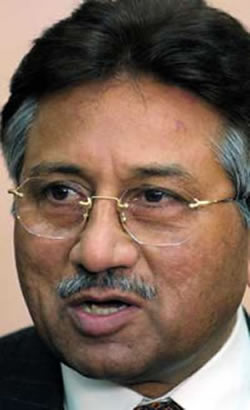

The Pakistani Government today published a picture of what it said was the severed head of the suicide bomber who killed Benazir Bhutto and offered a reward of almost £83,000 to anyone able to identify him.
Amid growing criticism of the police investigation into the opposition leader's killing, two pictures featuring men believed to be involved in the Rawalpindi shooting and suicide bombing were published today in Jang, the country's biggest-selling Urdu-language daily.
As well as an image of the severed head of a clean-shaven man who police suspect to be the bomber, another image - taken in the minutes before the blast - shows a young man wearing sunglasses and a dark waistcoat staring at the camera with a man wrapped in a white shawl standing directly behind him.
Alongside the pictures, the Government published a statement saying: "The people’s co-operation is being sought in this tragic incident and a picture of the criminals is being released."
It offered a reward of 10 million rupees (£82,645) for any information about the men, adding: "The name and address of the informant will be kept secret."
Later, in what appeared a further attempt to silence opposition anger over the conduct of the investigation, President Musharraf reversed the Pakistani Government's previous position and announced that he had requested foreign police help, with Scotland Yard sending out a team of officers by the end of the week.
The moves came amid huge tension between President Musharraf and his political opponents over the investigation into Ms Bhutto's killing.
The Pakistan People's Party (PPP), now headed by her widower, disputes Government claims that she died after cracking her head on the her car sunroof handle, pointing to a number of video and photographic images showing that she was shot as she waved to crowds before a suicide bomber blew himself up in the seconds afterwards.
Offers of assistance in the investigation have so far come from the United States, Britain and France.
Pakistan opposition PPP remains undecided on postponement of parliamentary elections
0 comments By Faraz NizamaniISLAMABAD, Jan. 2 (Xinhua) -- Slain former Pakistani prime minister Benazir Bhutto's Pakistan People's Party (PPP) announced Wednesday that it had not decided on what choices it would make on the postponement of parliamentary elections.
Addressing a news conference, newly-elected Co-Chairman of the PPP Asif Ali Zardari said that his party had to consult with other political parties on elections postponement.
Some local media quoted party sources as saying that the PPP would still contest the elections despite the postponement.
The Election Commission of Pakistan (ECP) announced on Wednesday that the polling date, which was originally set on Jan. 8, would be postponed till Feb. 18.
Zardari earlier said that any delay of the elections would be unacceptable to the PPP.
President Pervez Musharraf said at a televised address that the ECP was forced to come to its decision because of the damage incurred in riots following Bhutto's assassination.
Musharraf also disclosed that the government had invited a Scotland Yard forensic team to help probe Bhutto's assassination.
Zardari questioned why the Scotland Yard was not invited when Bhutto was attacked in Karachi on Oct. 19. Twin suicide bombing attacks hit Bhutto's procession, killing more than 140 people and injuring hundreds of others.
Monday, December 31, 2007
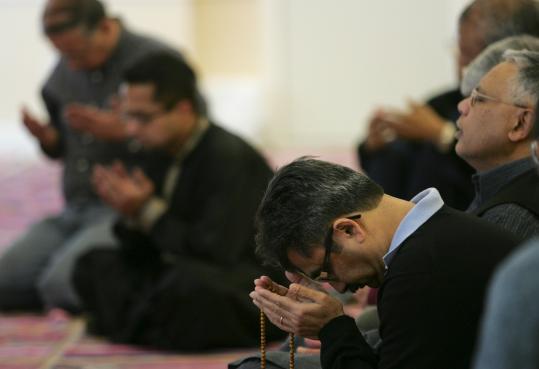
WAYLAND - Bowed down on bended knee, Muslim mourners rocked gently back and forth as they recited passages from the Koran under their breath. In a stone-quiet, rug-lined room, they quietly prayed for the departed soul of slain former Pakistani leader Benazir Bhutto, and that the country find its way from unrest to peace and prosperity.
Some 100 men and women gathered yesterday at a solemn religious ceremony, called a Quran Khawani, at the Islamic Center of Boston to pay tribute to Bhutto, the Pakistani opposition leader who was assassinated at a Dec. 27 political rally in Rawalpindi, Pakistan.
The mourners, many of whom had met Bhutto during her frequent visits to the Boston area and referred to her by first name, remembered her as a kind, courageous leader whose death has left the local close-knit Muslim-American community stricken with grief, anger, and fear.
"It's been devastating," said Dris Djermoun, president of the mosque. "She was a glimmer of hope for a country in turmoil. She was the face of democracy in a dictatorship. Now she's gone, and I can't fathom what's next."
At a round-table discussion after the prayer service, Tahir Chaudhry, president of the Pakistan Association of Greater Boston, compared Bhutto's assassination to John F. Kennedy's as a landmark political and cultural event.
"This is truly a 'Kennedy moment' for Pakistan," Chaudhry said. "It will be ingrained in our minds forever. But we hope that her very sad and tragic death will help restore democracy to Pakistan."
A two-time former prime minister, who in 1988 became the first woman to head the government of a Muslim nation, Bhutto returned to Pakistan in October after eight years in exile. Her death sparked widespread violence that has left at least 47 people dead.
Many who came to pay their respects yesterday are first-generation immigrants with family living in Pakistan who said they are deeply worried about family members in the volatile political climate.
"They are all so scared," said Humaira Kirmani, a 60-year-old from Lexington whose brother had to leave his car and walk 3 miles home to avoid riots and angry demonstrations in Karachi. "We are scared for them."
Kirmani wore a traditional Sindhi shawl that Bhutto had given her at a dinner party in 1969, when Bhutto was a student at Harvard University.
"I have felt so bad about what happened," she said. "I had to take it out today, to honor her memory."
Malik Khan, a former president of the mosque who lives in Boxborough, said the brutal, indiscriminate nature of the attack, which killed at least 20 others, has "put a cloud of anger, regret, and uncertainty over our community."
Khan and others said they admired Bhutto's courage in the face of great danger from Islamic extremists and said they were enraged at the barbaric nature of the attack, even more so because it targeted a woman.
"It's just the way of our culture," he said.
"A lot of people feel as if their daughter or sister has been hurt. She is the mother of children."
As mourners entered the mosque, they signed a condolence book next to flowers and a gold-framed picture of Bhutto, which she had inscribed to Barry Hoffman, Pakistan's honorary consul general in Boston.
Hoffman said her death, apart from its political ramifications, was a profound personal loss.
"She had that special magic," he said. "She would talk to you as though you were the most important person in the world."
Others criticized Bhutto as a flawed leader and sometimes divisive figure, but said her death has been a unifying force.
"A lot of people were disillusioned by the charges of corruption" aimed at her government, said Adil Najam, a Boston University professor of international relations.
"But you don't have to agree with her to be deeply saddened by her death. There is immense grief and fear of what comes next."
Najam speculated that Pakistanis were mourning "the culture of violence" that has gripped the country's political identity as much as Bhutto's death. But others said grief over Bhutto's murder crossed political boundaries.
"We have all become one," said Asmat Rafiq, a former commander in the Pakistani navy and a close family friend.
Amid fear of the current unrest, many said, was a flickering hope that her death would ultimately help advance the cause of democracy.
"She believed you needed democracy to root out the evils of dictatorship," said Faisal Khosa, 35, whose father is a legal adviser to Bhutto's party, the Pakistan

NAUDERO, Pakistan (AP) — Benazir Bhutto's supporters met Sunday to choose a successor to the slain opposition leader, with either her son or husband seen as favorites, while the country's ruling party said crucial Jan. 8 elections would likely be delayed up to four months.
Bhutto's assassination Thursday plunged the nuclear-armed country into a political crisis and triggered nationwide riots that left at least 44 people dead ahead of the parliamentary elections, seen by the United States and other Western nations as key to promoting stability in the country.
A key opposition party said that it would reverse an earlier decision to boycott the vote if Bhutto's group decided to run. Bhutto's Pakistan People's Party was expected to announce its decision later Sunday.
"We will definitely contest the elections if the PPP decides to contest," said Sadiq ul-Farooq, a senior member of former Prime Minister Nawaz Sharif's Pakistan Muslim League-N party.
THIS IS A BREAKING NEWS UPDATE. Check back soon for further information. AP's earlier story is below.
NAUDERO, Pakistan (AP) — Supporters of slain opposition leader Benazir Bhutto met Sunday to choose her successor, with either her son or husband seen as favorites, while the country's ruling party said crucial Jan. 8 elections would likely be delayed up to four months.
Bhutto's assassination Thursday plunged the nuclear-armed country into a political crisis and triggered nationwide riots that left at least 44 people dead ahead of the parliamentary elections, seen by the United States and other Western nations as key to promoting stability in the country.
Tariq Azim, information secretary of the Pakistan Muslim League-Q, said the vote would lose credibility if it was held now, with Bhutto's party in mourning and other opposition groups intent on boycotting. He expected authorities to announce a delay within 24 hours.
"How long the postponement will be for will be up to the Election Commission," he told The Associated Press. "I think we are looking at a delay of a few weeks ... up to three or four months."
Leaders of her Pakistan People's Party, meanwhile, were meeting Sunday in her ancestral home of Naudero in southern Pakistan to decide on a successor as party chief and its plans for the election.
"We will come up with a consensus, Bhutto's will and the meeting will determine it," Bhutto's husband, Asif Ali Zardari, told reporters when asked whether he wanted the post. "The party has a lot of brave people and a lot of brave leaders."
The Pakistan People's Party has yet to say whether it would boycott the vote if it goes ahead as planned. A pullout by the party could destroy the credibility of the elections, already being boycotted by Pakistan's other main opposition leader, Nawaz Sharif.
Police struggled to control the crowds in Bhutto's hometown of Naudero, many of whom had walked miles to get there. They shouted "Musharraf is a killer!" and called for the separation of Bhutto's home province of Sindh from the rest of Pakistan.
Controversy remained about whether she was killed by gunshots, a shrapnel wound or the concussive force of the blast. She was buried without an autopsy and the debate over her cause of death was undermining confidence in the government and further angering her followers.
On Saturday, the government rejected suggestions it should enlist foreign help in investigating Bhutto's assassination.
Democratic presidential candidate Hillary Rodham Clinton said Friday that an international probe into Bhutto's death was vital because there was "no reason to trust the Pakistani government." Others called for a U.N. investigation.
White House spokesman Tony Fratto said Pakistan had not officially requested U.S. help.
"It's a responsibility of the government of Pakistan to ensure that the investigation is thorough. If Pakistani authorities ask for assistance we would review the request," he said.
A senior U.S. official, however, said Pakistan was already "discussing with other governments as to how best the investigation can be handled."
With the United States, the discussions "are about what we can offer and what the Pakistanis want. Having some help to make sure international questions are answered is definitely an option," the official said, speaking on condition of anonymity because no agreement had yet come from the discussions.
There was no immediate confirmation from Pakistani officials.
British Foreign Secretary David Miliband offered his country's assistance. "Obviously it's very important that a full investigation does take place, and has the confidence of all concerned," he said.
The government has blamed the attack on Baitullah Mehsud, head of the Tehrik-i-Taliban, a newly formed coalition of Islamic militants along the Afghan border believed to be linked to al-Qaida and committed to waging holy war against the government.
But a spokesman for Mehsud, Maulana Mohammed Umer, dismissed the allegations as "government propaganda."
Bhutto's aides said they, too, doubted Mehsud was involved and accused the government of a cover-up.
"The story that al-Qaida or Baitullah Mehsud did it appears to us to be a planted story, an incorrect story, because they want to divert the attention," said Farhatullah Babar, a spokesman for Bhutto's party.
Authorities initially said Bhutto died from bullet wounds. A surgeon who treated her later said the impact from shrapnel on her skull killed her.
But Cheema said Friday that Bhutto was killed when the shock waves from the bomb smashed her head into the sunroof as she tried to duck back inside the vehicle.
Bhutto's spokeswoman Sherry Rehman, who was in the vehicle that rushed her boss to the hospital, disputed that.
"She was bleeding profusely, as she had received a bullet wound in her neck. My car was full of blood. Three doctors at the hospital told us that she had received bullet wounds. I was among the people who gave her a final bath. We saw a bullet wound in the back of her neck," she said. "What the government is saying is actually dangerous and nonsensical. They are pouring salt on our wounds. There are no findings, they are just lying."
Cheema stood by the government's version of events, and said Bhutto's party was free to exhume her body for an autopsy.
The election commission has called an emergency meeting for Monday to decide how to proceed with the parliamentary elections. Riots have destroyed nine election offices — along with the voter rolls and ballot boxes inside, the election commission said.
In the eastern city of Bahawalnagar, meanwhile, two suspected suicide bombers died early Sunday when they prematurely detonated their bomb near the residence of Ijazul Haq, a senior leader of the Pakistan Muslim League-Q party, police said. Haq was not at home at the time. The blast was the first suicide attack in Pakistan since Bhutto's assassination.
Friday, December 28, 2007

Her dead body was brought by a C-130 flight to Sukkur Airport from where it was taken to Moenjodaro by helicopter.
Along with the dead body of Benazir Bhutto, her husband Asif Ali Zardari, elder daughter Bakhtawar, younger daughter Asifa, son Bilawal, central leader of the PPP Makhdoom Amin Fahim, Shery Rehman and other persons arrived in Sukkur.
Here, her corps was shifted to an army helicopter and taken to Larkana. Her dead body, her husband Asif Ali Zardari, all three children, Amin Fahim, Shery Rehman and other 22 persons were taken to Larkana by a bus along with police security.
The helicopter left Sukkur for Moenjodaro Airport at 3-40 am.
The dead body will be taken from the Moenjodaro Airport to Garhi Khuda Bakhsh by ambulance.
Various groups are reaching Garhi Khuda Bakhsh from all over the country to attend the burial of benazir Bhutto.
Thursday, December 27, 2007
DUBAI, Dec 27 (AFP) - Supporters of slain Pakistani opposition leader Benazir Bhutto in the United Arab Emirates expressed shock and grief after she was assassinated in suicide attack on Thursday. “This is a big tragedy for Pakistan. This is a very big shock for us,” Zubeir Bashir, Middle East spokesman for Bhutto's PPP told AFP by telephone. He said that Benazir’s husband Asif Zardari and members of Bhutto family including their children who had remained in Dubai after her return to her homeland in October were already on their way to Pakistan.

Monday, December 24, 2007
RAHIM YAR KHAN: Former Prime Minister and Chairperson of Pakistan Peoples Party (PPP), Benazir Bhutto Monday pledged to launch projects for welfare of growers and poor if PPP comes into power after winning January 8 elections.
She was addressing a big public gathering here Mehmood Stadium kick off Punjab election campaign.
On Tuesday, Benazir Bhutto would address public gatherings in Lodhran and Muzaffargarh.
Chairperson of PPP would address a public meeting at Liaqat Bagh, Rawalpindi on 27th of December and Multan on 31st of December at 12 noon.
The former Prime Minister would visit Jahanian, Vehari and Pakpattan on 1st of January and Sahiwal, Kasur, Sheikhapura, Faisalabad and Gujarat, Gujranwala on 2nd, 3rd, 4th and 5th of January respectively.
According to the schedule, Benazir Bhutto would be addressing a public gathering in Lahore on 6th of January.


ISLAMABAD: The Pakistan People’s Party (PPP) Chairperson, Benazir Bhutto, is making waves in New Delhi where she is in the midst of a controversy, but even though she is busy in electioneering at home, she has had time to hit back at allegations that she went back on promises. It started with Indian National Security (INS) Adviser M K Narayanan’s comments, accusing Benazir of unfulfilling promises made to New Delhi in 1988; he was asked about Benazir.
“One has to go by what she did in the nineties. One is always a little skeptical. It is possible, but her track record is not necessarily something, which will make us believe that she would follow to the letter of what she has said—I think even if she wishes to do so. As I mentioned earlier, the single most important entity in Pakistan remains the army and along with that ISI. I find it extremely difficult to believe that Prime Minister Benazir Bhutto, if she becomes that, will have a free hand in doing all the things that she wishes to do. I know that in 1988 when she met Prime Minister Rajiv Gandhi, she made a number of promises. We know almost certainly that she was sort of curbed by the military at that point but whether she will have success now is difficult to believe and it would be very optimistic to expect that she can fulfill whatever she says but we hope that she will do her best,” he said.
Narayanan made these remarks in a television interview. On Saturday, Benazir hit back at Narayanan in an interview with Outlook. “If anyone kept their word, it was me, not Rajiv. He went back to India and then called me on his way to the Commonwealth to say that he could not keep his promise to withdraw from Siachen and that he would do it only after the elections. Now, if I haven’t raised the subject or complained all these many years, why is it being raised now?” Trying to refresh Narayanan’s memory, she asked, “Does anyone remember those times or is public memory so short that no one recalls the extremely difficult conditions India faced during the Sikh insurgency 20 years ago? India was in a complete mess. Does anyone remember that it was I who kept my promise to Prime Minister Rajiv Gandhi when we met and he appealed to me for help in tackling the Sikhs? Has India forgotten December 1988? Have they forgotten the results of that meeting and how I helped curb the Sikh militancy?”
Recalling her meeting with Rajiv in Islamabad, she said, “Nobody else knew what Rajiv and I discussed. There was no fly on the wall. How can anyone say I have not kept my promises to him when the single biggest result of that meeting was the end of the Sikh insurgency? It was Rajiv, who committed to me that he would withdraw from Siachen. I made no promises that could have been broken.”
She said after the former prime minister was assassinated she tried but could never establish the same kind of rapport with the government that followed. But despite the slight chill, there was no war with India when she was prime minister, she added.
“Not only was there no war, in fact there was peace because I nixed the idea of Kargil. Has India forgotten all of this? When I was prime minister you did not have the Mumbai bomb blasts, you did not have the attack on Parliament. There was no Kargil,” she added.
Benazir said that she made no promises on Kashmir because there were no discussions on Kashmir. “Why does India believe I will break my word, imply I cannot be trusted?” Benazir then added, “I believe we share so much a belief in democratic values, in democracy and human rights. I am very disappointed to hear that Delhi does not think so.”
Meanwhile, the New Indian Express in an editorial asks why Narayanan has taken on Benazir and put full trust in Pervez Musharraf. The editorial is more sympathetic towards Benazir. “Narayanan finds Mr Musharraf, who was responsible for taking his country down the path to Kargil a far more credible interlocutor than Benazir Bhutto.
This clownish and potential flag-waver in Srinagar, is the person in whom Mr Narayanan implicitly has reposed his faith in, the man who even the NSA admits, is only tactically restraining some jehadis from running around freely; Mr Narayanan has implicit faith in the man who has failed to deliver on the join terror mechanism; he believes more in the man who controlled the establishment against whom the NSA declared he had “pretty good evidence” against soon after the Mumbai train blasts, the man even the Americans are now cutting to size. How will this sort of loose talk go down in Pakistan, with Benazir more particularly? Will she keep quiet? Will it colour her view of the Indian Establishment? What do we get out of gratuitous comments like this? In the ‘eighties Kashmir insurgency was less of a problem than the Sikh insurgency in Punjab. Especially considering the fact that after her meeting with Rajiv Gandhi in 1988, Benazir paid the price, for among other things, handing over a detailed dossier of local operatives Pakistan was using to foment the Punjab insurrection,” the editorial says.
By Mariana Baabar

Pakistani opposition leader and former Prime Minister Benazir Bhutto has accused government security forces of pressuring candidates to drop out of next month's elections.
Ms. Bhutto told reporters during a campaign stop Thursday that the government is sending intelligence officials to ask candidates to withdraw.
Next month's elections are for assemblies in Pakistan's four provinces and a national assembly from which a prime minister and a government will be chosen.
The vote is seen as a three-way race among the opposition parties of former prime ministers Nawaz Sharif and Benazir Bhutto and President Pervez Musharraf.
However, opposition political figures accuse Mr. Musharraf of already rigging the balloting to favor his supporters.
In other news, Pakistani authorities have temporarily released lawyer and opposition figure Aitzaz Ahsan for three days to celebrate the Muslim holiday of Eid al-Adha.
Ahsan, a senior figure in Ms. Bhutto's Pakistan People's Party, was detained last month under emergency powers that President Musharraf invoked on November 3.
He served as lead counsel for Supreme Court Chief Justice Itikhar Chaudhry, whose suspension earlier this year triggered nationwide protests.
The protests led to Mr. Musharraf's declaration of emergency rule and his dismissal of Chaudhry and other judges seen as hostile to the president's reelection while he remained army chief.
Tuesday, December 18, 2007
Pakistan’s president Pervez Musharraf has been a key member of the coalition in the “war on terror”, in particular by supporting US efforts to root out Osama bin Laden. Yet Musharraf was a general, now officially out of uniform, who took power in his country in a coup in 1999, and who recently introduced a state of emergency that has seen leading political figures placed under house arrest. These actions sit ill with US president George Bush’s commitment, in his 2005 inauguration speech, to “seek and support the growth of democratic movements and institutions in every nation and culture, with the ultimate goal of ending tyranny in our world”.
The problem for those observing current events in Pakistan is that the country’s democratic politicians have, in their attempts to govern, hardly covered themselves with glory. Zulfiqar Ali Bhutto, prime minister from 1973 to 1977, was executed for involvement in the murder of political rivals. His daughter, Benazir, twice prime minister, was convicted in 1999 of corruption. Her great political rival, Nawaz Sharif, twice dismissed for corruption, was convicted in April 2000 on terrorism and hijacking charges.
Even taking aside the peccadilloes of its rulers, Pakistan is a country wrought by faction. Of its four provinces, Baluchistan, North-West Frontier Province, Punjab and Sindh, only Punjab lacks an independence movement that at some point has aimed to break away. North-West Frontier Province remains in large parts beyond the control of Islamabad and is believed to be the hiding place of Taliban from Afghanistan, and of members of Al-Qaeda.
The country also suffers from religious intolerance, between Sunni and Shia muslims and, within the Sunni community, between Islamists and secularists. Periodic religious conflicts have punctuated Pakistan’s history: indeed the current crisis was precipitated by the storming of the radical Red Mosque in Islamabad, which, the government claimed, was a breeding ground for Islamic extremists.
ISLAMABAD, Dec. 17 -- A total of 7,335 candidates are in the run for the national and provincial assemblies seats in Pakistan's upcoming parliamentary elections, the country's election commission announced here Monday. The parliamentary elections are set for Jan. 8, 2008. A total of 2,252 candidates will contest on the 272 National Assembly seats in the 342-member house. The other seats will be filled with special seats for women and minorities. Another 5,083 candidates will run for general seats of the four provincial assemblies. Officials said that the publishing of ballot papers started Monday and the process would complete by Jan. 5. The election officials have also started dispatching polling materials to the local offices. For the first time, transparent ballot boxes have been imported to avoid any rigging in the polls.