Wednesday, July 2, 2008
MADRID, Spain (CNN) -- Saudi Arabia on Tuesday ruled out further increases in crude production following its June 23 announcement that it would pump an extra half-million barrels a day.
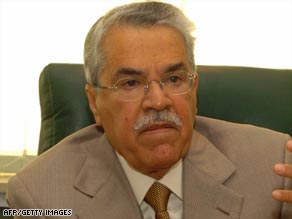
In an interview with CNN, Saudi Oil Minister Ali al-Naimi said he was troubled by the current high levels of petroleum prices, but added, "We have nothing to do with prices where they are today."
He denied the problem is one of immediate oil supply.
Asked whether Saudi Arabia, OPEC's leading producer, would open its taps to its reported maximum capacity of 11 million barrels a day, al-Naimi did not dispute the figure but asked rhetorically, "Where is the buyer?"
Al-Naimi was speaking to CNN on the sidelines of the four-day World Petroleum Congress in Madrid, Spain, where leaders of the oil industry from around the world are meeting. They include government ministers, national oil company leaders, and international oil company bosses.
Al-Naimi ruled out an option advanced by some oil-watchers: to make more Saudi Arabia heavy crude available, but at a discount in order to bring prices down.
Video Watch Charles Hodson's interview with Ali al-Naimi »
"That is not the way the market works," he told CNN.
Pressed on the issue of market perceptions that foresee future crude supply falling behind the expected growth in global demand, the minister said such perceptions were "wishful thinking."
Al-Naimi said Saudi Arabia will be investing $129 billion over the next few years on expanding its production capacity to 12.5 million barrels a day in the interests of remaining "the pre-eminent supplier" of the world's petroleum.
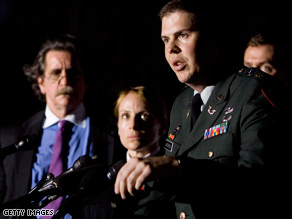
WASHINGTON (CNN) -- A military judge will hold separate hearings for five men accused in the September 11 terrorist attacks to determine if they were intimidated into asking to represent themselves.
Defense lawyers say Marine Col. Ralph Kohlmann, the judge in the case, scheduled individual appearances for the detainees on July 9 and 10 in response to claims that one of the defendants may have influenced the others to join him in rejecting lawyers.
Last month, all five detainees made their first appearance together before Kohlmann and told him that they wished to represent themselves on charges stemming from the September 11 attacks.
At the June 5 hearing, Kohlmann agreed to let Khalid Sheikh Mohammed, Walid bin Attash and Ali Abdul Aziz Ali represent themselves. He reserved judgment on Mustafa al-Hawsawi and Ramzi bin al-Shibh.
Immediately after the hearing, al-Hawsawi's lawyer said that Mohammed had intimidated his client into asking to represent himself.
"It was clear that Mr. Mohammed was attempting to intimidate Mr. al-Hawsawi into not accepting me as counsel," said Army Maj. Jon Jackson, whose client is accused of helping finance the attacks.
Jackson noted that Mohammed, the accused mastermind of the plot, had exchanged words with his co-defendants during the hours-long hearing, where he said he wanted a death sentence so he could become a martyr.
"Al-Hawsawi never said he wanted to plead guilty or martyr himself," Jackson told CNN.
Navy Lt. Cmdr. Suzanne Lachelier, bin al-Shibh's attorney, said her client may not be fit to decide on his representation because he is being medicated.
Lachelier said the information she has received limited information about bin al-Shibh's medical condition, including a list of drugs but no information about why the drugs were prescribed.
According to Lachelier, Kohlmann has ordered a medical report on bin al-Shibh, who is accused of coordinating the attacks, by August 8 and a hearing on his mental status on August 15.
"I think that's a reasonable reading of the rules," she said, adding that it ignores a separate issue of whether bin al-Shibh is competent to act as his own lawyer.
advertisement
During the June hearing, bin al-Shibh was the only defendant who was shackled.
"I have been seeking martyrdom for five years," he said. "I tried for 9/11 to get a visa, and I could not."
CARACAS, Venezuela (AP) -- An attorney says Venezuela's military has detained a dissident army general who opposes the socialist ideology espoused by President Hugo Chavez.
Jose Zaa is the attorney for Army Gen. Angel Vivas Perdomo. He says his client was being held Tuesday by agents belonging to the Military Intelligence Directorate.
Vivas Perdomo has asked Venezuela's Supreme Court to toss out Chavez's order for troops to salute with the motto "fatherland, socialism or death -- we will triumph." The general claims the motto is unconstitutional and that it violates the military's apolitical tradition.
Vivas Perdomo was engineering director at the Defense Ministry until January 2007, when he left after complaining that Chavez was imposing the socialist motto.

President of Mongolia Nambaryn Enkhbayar has declared a state of emergency in the capital after a post-election political rally descended into violence.
President Nambaryn Enkhbayar
Police were blocking major arteries into the capital Wednesday after the president suspended most television broadcasts and imposed an overnight curfew in Ulaanbaatar, the capital, said William Infante, Mongolia director for The Asia Foundation, a nonprofit organization that seeks to bolster democratic institutions.
The demonstrators were upset about the prospect of a victory in last Sunday's parliamentary elections by the ruling Mongolian People's Revolutionary Party, Infante said.
"I think Mongolians are shocked. This was completely unexpected," he said. "The sentiment is one of profound disappointment."
Five people were killed, several hundred were hurt and another few hundred were detained, Infante cited local news reports as saying. State television in Mongolia showed the prime minister viewing bodies in a morgue, he added. Video Watch as protesters mob the ruling party headquarters »
The U.S. Embassy said Wednesday it was "deeply concerned about the violence" that prompted the state of emergency.
advertisement
Enkhbayar acted after several thousand demonstrators at an opposition political rally broke into and burned the offices of another party, said Infante, who said he saw the smoke and flames from his nearby office.
The violence was unusual for Mongolia, which made the transition from communism to democracy in the early 1990s. Four previous parliamentary elections were free and fair, and they passed without incident, Infante said.

Wednesday, February 13, 2008
CHICAGO -- Living to 100 is easier than you might think. Surprising new research suggests that even people who develop heart disease or diabetes late in life have a decent shot at reaching the century mark.
"It has been generally assumed that living to 100 years of age was limited to those who had not developed chronic illness," said Dr. William Hall of the University of Rochester.
Hall has a theory for how these people could live to that age. In an editorial in Monday's Archives of Internal Medicine, where the study was published, he writes that it might be thanks to doctors who aggressively treat these older folks' health problems, rather than taking an "ageist" approach that assumes they wouldn't benefit.
For the study, Boston University researchers did phone interviews and health assessments of more than 500 women and 200 men who had reached 100. They found that roughly two-thirds of them had avoided significant age-related ailments.
But the rest, dubbed "survivors," had developed an age-related disease before reaching 85, including high blood pressure, heart disease or diabetes. Yet many functioned remarkably well -- nearly as well as their disease-free peers.
Overall, the men were functioning better than the women. Nearly three-fourths of the male survivors could bathe and dress themselves, while only about one-third of the women could.
The researchers think that may be because the men had to be in exceptional condition to reach 100. "Women, on the other hand, may be better physically and socially adept at living with chronic and often disabling conditions," wrote lead author Dr. Dellara Terry and her colleagues.
Rosa McGee is one of the healthy women in the study who managed to avoid chronic disease. Now 104, the retired cook and seamstress is also strikingly lucid.
"My living habits are beautiful," McGee said in an interview at her daughter's Chicago apartment. "I don't take any medicines. I don't smoke and I don't drink. Never did anything like that."
Until late 2006, when she fell in her St. Louis home, McGee lived alone and took care of herself. Now in Chicago, she is less mobile but still takes walks a few times weekly down the apartment building hallways, with her daughter's help.
McGee credits her faith in God for her good health. She also gets lots of medical attention -- a doctor and nurse make home visits regularly.
Genes surely contributed -- McGee's maternal grandparents lived to age 100 and 107.
But while genes are important, scientists don't think they tell the whole story about longevity.
A second, larger study of men in their 70s found that those who avoided smoking, obesity, inactivity, diabetes and high blood pressure greatly improved their chances of living into their 90s. In fact, they had a 54 percent chance of living that long.
Their survival decreased with each risk factor, and those with all five had only a 4 percent chance of living into their 90s, according to Harvard University researchers.
Those who managed to avoid lifestyle-related ailments also increased their chances of functioning well physically and mentally two decades later.
The study followed 2,357 men for about 25 years or until death, starting in their early 70s. About 40 percent survived to at least age 90. Among survivors, 24 percent had none of the five risk factors.
"It's not just luck, it's not just genetics. ... It's lifestyle" that seems to make a big difference, said lead author Dr. Laurel Yates of Harvard's Brigham and Women's Hospital.
"It's get your shoes on, get out there, and do some exercise," she said. "These are some things you can do" to increase the chances of a long life.
Yates said it's never too late to adopt a healthier lifestyle, though the findings don't address whether waiting until age 70 to stop smoking, lose weight and exercise will increase longevity.
Hall noted that the United States has more than 55,000 centenarians, and that Americans 85 and older are the country's fastest-growing group of older adults.
He said the new research underscores how important it is for doctors to become adept at treating the oldest of the old, who are "becoming the bread and butter of the clinical practice of internal medicine."